Industry Knowledge
Jiangsu Liangwang Technology Co., Ltd. — food-grade packaging manufacturer, Suzhou, China
Jiangsu Liangwang Technology Co., Ltd. manufactures food-grade packaging containers, and our Fresh Food Tray range is built for raw meat, seafood, fruit, vegetables and frozen ingredients. Trays are thermoformed in PP, PET and PS, with breathable or airtight structures selected to match the preservation technology used on the packing line.
As one of the disposable plastic food packaging trays manufacturers serving export markets, we run a Class 100,000 GMP purification workshop and laboratory, German ILLIG thermoforming equipment and flip-mold cup machines, with a planned annual production capacity of 20,000 tons. Management systems include ISO9001, ISO14001, ISO45001, ISO22000 and BRC Grade A. Trays ship to the United States, Japan, Canada and other markets.
Our Fresh Food Tray Range
Four sub-series cover the main cold-chain packaging formats. Each one is a different answer to the same question: how the tray interacts with film, gas, temperature and the display case.
Fresh Food Skin Pack Tray
Vacuum skin packaging (VSP) trays where film forms directly over the product. Strong presentation for beef, pork, lamb and deli cuts, with reduced drip loss and a clean retail face.
Modified Atmosphere Fresh Food Tray
MAP trays with sealing rims engineered for gas flushing and lidding film. Used for salmon, poultry, prepared meat and produce where shelf life is set by the gas mix.
Wood Grain Fresh Food Tray
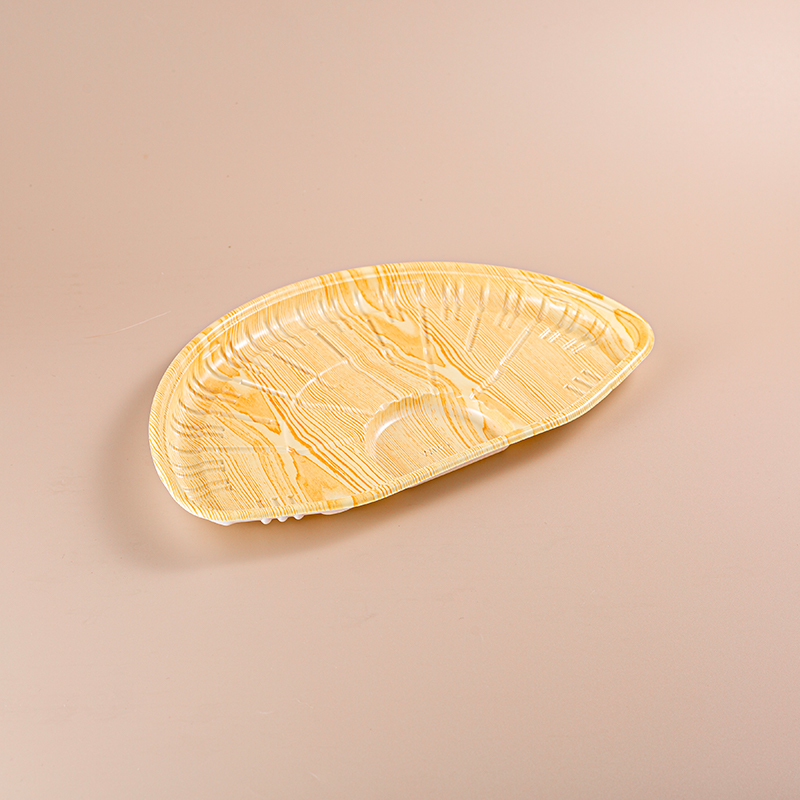
Textured PP trays with a wood-grain surface finish. The tactile, natural look suits butcher counters, premium meat and supermarket display where the tray is part of the brand presentation.
Frozen Food Tray
Trays formulated for low-temperature toughness, so the body resists cracking during blast freezing, stacking and transport of frozen portions.
Matching Tray Format to Application
The table below reflects how we normally map a product and a packing line to a tray format. Final geometry, wall thickness and rim design are confirmed against the customer's sealing or skin equipment.
| Tray format |
Typical product |
Sealing / film interface |
Primary benefit |
| Skin pack (VSP) |
Beef, lamb, pork, seafood portions |
Skin film drawn over product |
Product locked in place, minimal purge |
| Modified atmosphere (MAP) |
Salmon, poultry, prepared meat, cut produce |
Lidding film, gas flushed |
Extended chilled shelf life |
| Wood grain |
Fresh meat, butcher counter, deli |
Overwrap or lidding film |
Natural display appearance |
| Frozen food tray |
Frozen portions, seafood, pre-made items |
Film or board lid |
Low-temperature impact resistance |
Materials and Structural Choices
Material selection follows the food, the process temperature and the market's packaging rules. PP is the workhorse for meat and frozen formats; PET and PS cover clear display and chilled applications; bio-based options are available where plastic-reduction targets apply.
- Plastic series — PP / PET / PS: suited to fresh produce, chilled meat, seafood and frozen goods, with hot- and cold-fill tolerance depending on grade.
- Fully degradable series — PLA / bagasse / wheat straw / bamboo fiber: for markets with plastic-restriction policies.
- Paper-based series — food-grade coated and laminated paper: where a fibre-forward look is required.
- Composite solutions: material and structure combinations recommended against the specific product characteristics.
Configuration Options We Build Into a Tray
Beyond the standard catalogue, trays are configured around the packing line and the retail format. These are the variables we adjust most often.
- Geometry: rectangular, square, round or compartmented bodies; tapered or straight walls for denesting and stacking.
- Rim and flange: width and flatness tuned to the sealer or skin machine's sealing window.
- Surface finish: matte, high-gloss, pearlescent, frosted, embossed or wood grain.
- Barrier behaviour: breathable or airtight structures matched to the preservation method.
- Brand presentation: colour, embedded logo printing, embossing and in-mold labeling.
- End-user handling: easy-peel film and easy-tear opening where the retail pack requires it.
Line Integration and Installation
Trays are only as good as their behaviour on the machine. We work from the customer's sealing, skin or MAP equipment parameters — die footprint, sealing dwell, vacuum level, gas mix and cycle rate — so the tray nests, indexes and seals without line stoppages.
For new lines, tray dimensions are agreed before mold manufacture, and sample trays are tested on the customer's equipment or against agreed sealing conditions. Stack height, denesting force and rim flatness are the three points that most often decide whether a tray runs cleanly at production speed.
Quality Control and Acceptance
Production runs in our disposable plastic food packaging trays factory inside a Class 100,000 GMP purification workshop with an on-site laboratory. System certifications held include ISO9001, ISO14001, ISO45001, ISO22000 and BRC Grade A, and FDA certification is listed among our credentials.
- Incoming material and food-contact grade verification.
- Dimensional and rim-flatness checks against the approved drawing.
- Weight and wall-thickness control for consistent sealing performance.
- Pre-shipment sampling and retained samples for traceability.
Customization and Development Process
Our R&D team handles ODM and OEM work across materials and structures, from mold making through sampling to mass production. The sequence we follow is fixed so that tooling decisions are not made before the packaging requirement is clear.
- Needs communication — product, process and market requirements.
- Solution concept — material, structure and format proposal.
- Mold manufacturing.
- Sample testing on the intended packing conditions.
- Mass production.
- Quality control and shipping.
Information We Use to Configure Your Solution
To return a workable tray specification and quotation, we need the following project inputs. Where a value is still open, we propose a starting point and confirm it at sampling.
| Input |
Why we need it |
| Product type and portion size |
Sets cavity depth, base profile and compartment layout |
| Packing technology (skin, MAP, overwrap, frozen) |
Determines rim design, barrier behaviour and material grade |
| Sealing or skin machine model and die footprint |
Ensures the tray fits the tooling and seals within the cycle |
| Temperature range (chill, blast freeze, display) |
Selects impact-modified grades for frozen formats |
| Target shelf life and gas mix |
Drives MAP tray structure and film compatibility |
| Colour, finish and branding requirements |
Defines surface treatment and decoration method |
| Annual volume and order pattern |
Sets tooling plan, MOQ and production scheduling |
| Destination market and compliance requirements |
Confirms material eligibility and documentation scope |
Related Packaging in Our Range
Fresh food trays sit alongside the rest of our food-grade packaging, so a single project can be sourced across formats. Our Eco-friendly Food Container range covers takeaway and prepared-food formats, and the Disposable Plastic Cup series covers beverage service in PP, PET and PLA.
Frequently Asked Questions
Which tray format suits fresh meat and seafood?
Skin pack trays are the usual choice for premium cuts because the film locks the product and limits purge. For salmon and poultry where shelf life is controlled by gas, modified atmosphere trays with a sealing rim are the better fit. Both are produced in food-grade PP.
Can you produce trays to fit our existing sealing machine?
Yes. We work from your machine model and die footprint, then confirm rim width, flange flatness and stack height at sampling. Trays are tested against the intended sealing or skin conditions before mass production.
What is the minimum order quantity and lead time?
Our MOQ is 5,000 pcs. Standard delivery is generally 15–30 days after order confirmation, and small batch orders are completed within half a month of confirmation. Tooling and sampling add time to the first order.
Do you offer custom colours, finishes and branding?
Customization is available. We produce matte, high-gloss, pearlescent, frosted, embossed and wood-grain finishes, and support embedded logo printing, embossing and in-mold labeling for brand presentation.
Which certifications apply to your fresh food trays?
Our management systems include ISO9001, ISO14001, ISO45001, ISO22000 and BRC Grade A, and FDA certification is held. Trays are produced in a Class 100,000 GMP purification workshop with an on-site laboratory.
How do we start a fresh food tray project?
Send the product type, packing technology, machine details, temperature range, target volume and destination market. We respond within 24 hours on business days with a configuration proposal and quotation, then move to mold making and sampling.
Related Products and Categories
If your project needs a different tray colour or presentation, our orange food plastic tray shows how a skin pack format can be finished for retail display while keeping the same sealing and film performance.


 English
 Español